
Ellis County Court Records After Jail Arrest
Court records after a jail arrest in Ellis County follow a separate track from the jail log. The jail side begins with arrest, transport to Ellis County Jail, booking, identity entry, property handling, photo and fingerprint steps when they apply, screening, bond or hold review, and a housing assignment. The court side begins when the Ellis County Attorney reviews the arrest material and files charges. That filing creates the criminal case record in the 23rd Judicial District, where the case can show the defendant name, case number, filed counts, hearing dates, bond entries, warrant activity, and final disposition.
The county jail log is useful, but it is not a filed criminal complaint. The official log lists custody facts such as name, booking number, booking date, date of birth, sex, race, inmate number, and housing. It does not show charges, bond, arresting agency, court dates, or release status. For custody and booking fields, use the Ellis County jail inmate records page. For booking photo questions, use the Ellis County jail mugshots page. Court records after an arrest answer a different question: what charge did the prosecutor file, and what happened in court?
The practical flow is simple: arrest, booking, first appearance, prosecutor charge review, then court case. First appearance is the early court step where release terms, counsel, and next settings may be addressed. A charge filed at that stage can later be amended, reduced, dismissed, or resolved by plea, trial, diversion, or another disposition. Do not treat a booking label, a warrant hold, or a jail phone summary as the final court record.
Find Ellis County Court Records
The main online court channel is Kansas District Court Case Search. The 23rd Judicial District also links court record tools from its Court Dockets page, where the Ellis County Jail Log is posted under a separate jail-log area. The Kansas Judicial Branch says public district court records can also be searched at courthouse public computers, so an online search is not the only path when a name search fails or a case is old, sealed, limited, or hard to match.
The portal is a court case index, not a jail roster. Search by name when the case number is unknown. Use the booking date from the jail log as a clue, then compare county, case type, filing date, and party name before assuming a match. For traffic cases, a citation number may be a better key than a name. If the online search does not show a case, contact the Ellis County District Court clerk because a case may not be filed yet, may be restricted, or may need in-person access.
The Kansas Case Search portal is the source shown here. Its fields are broad because case access can vary by user role and record type.
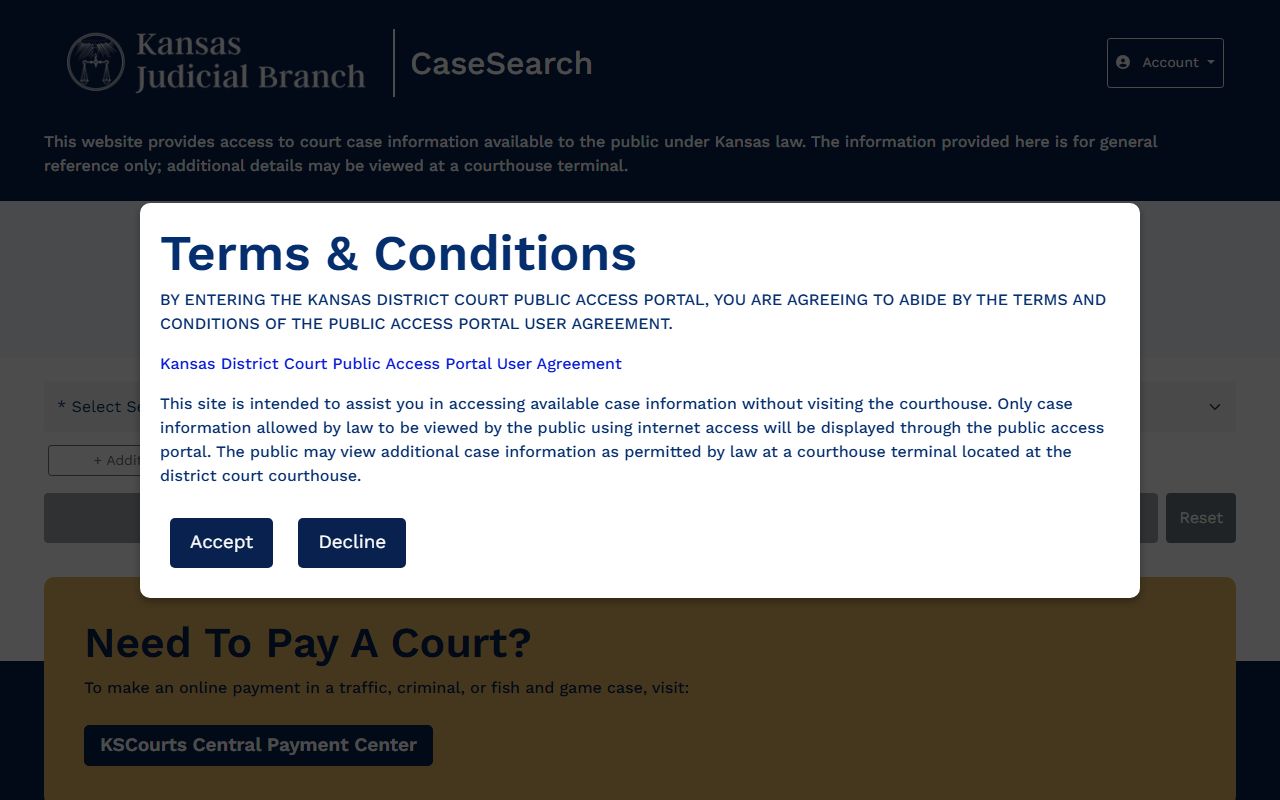
Use this case-search screen for filed court records after an Ellis County jail arrest, then confirm uncertain matches with the clerk.
| Field Label | Type | Required | Options or Format Notes |
|---|---|---|---|
| Case number | Search option | Optional | Best when the number is printed on a notice, bond paper, citation, or prior docket entry. |
| Party name | Search option | Optional | Use the defendant first and last name. Compare date of birth or other clues when names are common. |
| Business name | Search option | Optional | Used for entity parties, not most jail-arrest criminal cases. |
| Citation | Search option | Optional | Useful for Ellis County or Kansas Highway Patrol traffic violations. |
| Other role criteria | Search option | Optional | The portal notes that some criteria depend on the user role and record access level. |
| Search | Button | Not applicable | Runs the query after the selected search path is entered. |
Ellis County Arrest Charges Filed
The Ellis County Attorney's Office handles the local prosecution step. Kansas counties use a County Attorney title here, not a District Attorney title. The office says it is primarily responsible for misdemeanor and felony criminal prosecution. It also handles Ellis County and Kansas Highway Patrol traffic violations, juvenile offender cases, child in need of care matters, alcohol or drug care and treatment cases, and mental illness matters. For court records after a jail arrest, that office is the charging agency that turns arrest facts into a filed criminal case.
A charging document is the written accusation that starts or frames the court case. The terms can vary with the type of case and procedure. A complaint is a common starting paper in criminal court. An information is a formal prosecutor-filed charge, often used in felony cases. An indictment comes from a grand jury process and is less common in routine county filings. The important point for Ellis County court records is that the filed document may not match the first booking label. The prosecutor may decline one count, add another, or choose a different severity level after review.
| Document | Who Files It | Common Use | What to Check |
|---|---|---|---|
| Complaint | Prosecutor or law enforcement process through the court | Initial criminal accusation, including many misdemeanor filings | Count list, statute references, offense dates, and defendant name. |
| Information | Prosecutor | Formal charging document often used for felony prosecution | Whether counts changed after first appearance or preliminary steps. |
| Indictment | Grand jury | Grand-jury charge in selected serious or special matters | Whether the case began by grand jury rather than ordinary complaint filing. |
The County Attorney image comes from the official Ellis County Attorney page, which describes the office's prosecution role and priorities.
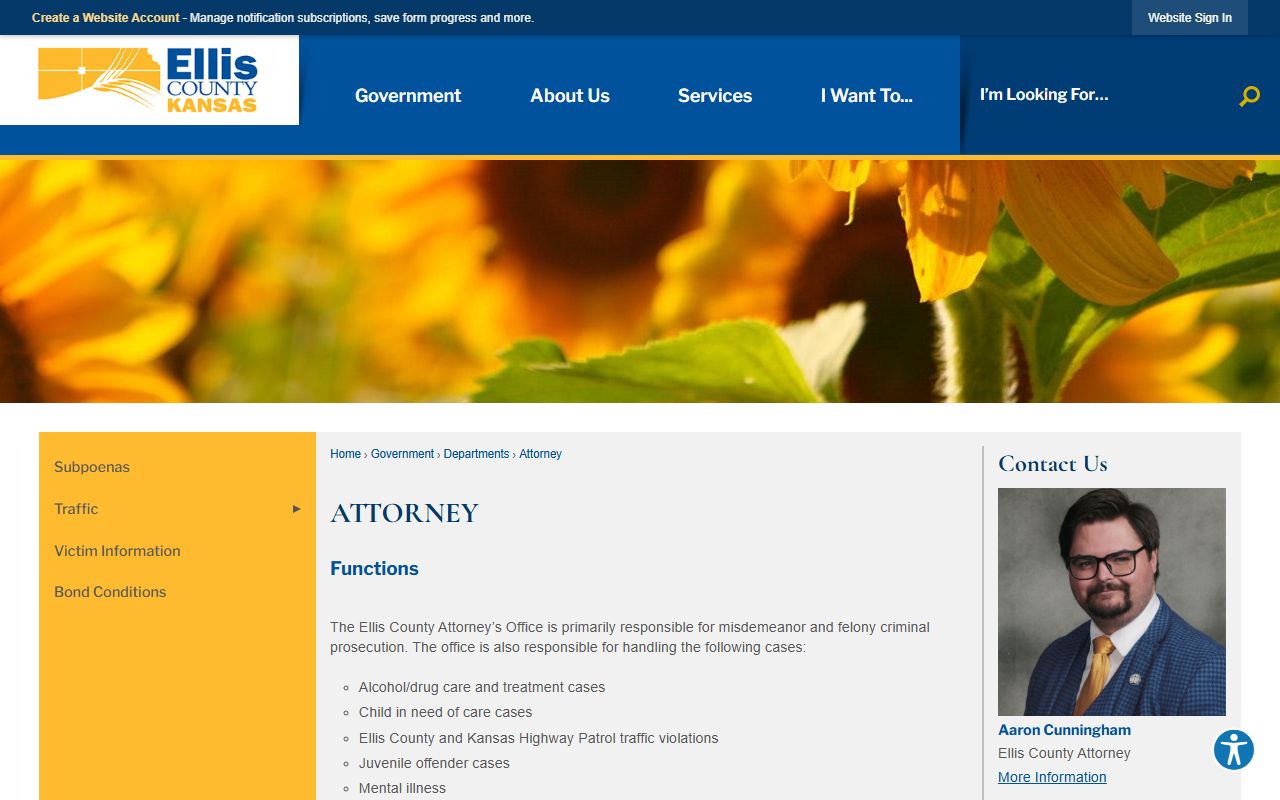
That local prosecution role is why the court charge record can differ from the arrest or booking information held by the jail.
Ellis County Charge Status
Charge status is the current court position of a count. A pending charge is still open. An amended charge has been changed from an earlier form. A reduced charge usually means the level or offense was lowered. A dismissed charge is no longer being pursued in that case. A conviction means guilt was established by plea or verdict. Diversion may allow a case to be handled under agreed terms without the same result as a conviction, depending on the case and the order.
Read each count on its own. One Ellis County arrest can produce more than one count, and each count can end in a different way. A case may show one count dismissed while another count results in a plea. A bench warrant entry can also appear during the case if the defendant misses court or violates a court order. That is why the current status line matters more than the first charge label seen after booking.
| Status | What It Means | Why It Matters |
|---|---|---|
| Pending | The charge is still open in court. | Future hearings, bond terms, and plea or trial settings may still change the result. |
| Amended | The charge text, level, count, or statute reference changed. | The newest court entry may be more accurate than the original arrest description. |
| Reduced | The charge was lowered to a lesser offense or severity. | Sentencing range, collateral impact, and plea terms may be different. |
| Dismissed | The count was dropped by order or prosecution action. | A dismissed count is not the same as a conviction, though the case record may remain public unless restricted or expunged. |
| Convicted | Guilt was established by plea or verdict. | The record moves from accusation to final adjudication for that count. |
| Warrant active | A court warrant is tied to the case. | Release, bond, and appearance questions should be checked with the court or jail. |
Bond After Ellis County Arrest
Bond is the release path set by the court or allowed under court authority. The Ellis County Sheriff's Office says jail deputies handle bonding, and the county deposit information notes that inmate funds may be used for bond. The jail log itself does not publish bond amounts, charges, or holds, so bond should be confirmed by calling Ellis County Jail, checking the filed case, or contacting Ellis County District Court after a case opens.
Common Kansas bond terms include cash bond, surety bond through a licensed bail agent, personal recognizance release, and no-bond or hold status. A PR bond means the person may be released on a promise to appear without posting the full cash amount. A detainer is a hold request from another agency. Holds can block release even when a bond amount appears on one case. Examples include another county warrant, a KDOC or parole hold, a federal hold, an ICE detainer, or a no-bond order.
- Confirm whether the person is in Ellis County Jail or listed as out-of-county on the official jail log.
- Call the jail at (785) 625-1050 for current bond and hold status before trying to post money.
- Search Kansas Case Search after filing to see whether bond, hearings, or warrants appear in the case.
- Ask whether payment belongs at the court, jail, or through a bonding company before going in person.
Note: A bond on one case does not clear a separate warrant, detainer, probation hold, or no-bond court order.
Ellis County Warrants And Court Records
No official Ellis County active warrant search page was found in the county and sheriff sources reviewed. The sheriff's division description says patrol deputies perform warrant service. The 23rd Judicial District also notes that sheriffs should efile returns on summonses, subpoenas, orders to appear, contempt citations, state tax warrants, arrest warrant returns, and bench warrant returns when a case is already in court. That means warrant activity may appear in a court case even though there is no public sheriff warrant list.
Different warrants mean different things. An arrest warrant authorizes custody based on a criminal matter. A bench warrant is usually issued by a judge after a missed court date or court-order problem. A search warrant authorizes a search and is not the same as a custody warrant. A probation or parole warrant can hold a person for supervision issues. An out-of-county warrant may keep someone in Ellis County Jail until the issuing county acts. Federal warrants are handled through federal channels and may not be fully explained in county records.
For warrant questions, call the sheriff's office at (785) 625-1040 for routing, call the jail at (785) 625-1050 for custody questions, search the court case for bench-warrant entries, or contact the issuing municipal court or police department. Clearing a warrant usually requires appearing in the issuing court, posting bond if allowed, or working with counsel to arrange a surrender or court appearance. VINE is for custody notification after arrest, not for pre-arrest warrant searches.
Ellis County Court Contacts
Ellis County District Court is the local clerk channel for filed district court cases. The court is at 107 W. 12th St., Hays, KS 67601. Phone is 785-628-9415, fax is 785-628-8415, and the listed email is Ellis_County_Clerk@kscourts.gov. The court page lists public hours as open 8-12 and 1-5, closed to public at 4:30. Courthouse security rules matter for in-person record checks or hearings: visitors should expect screening and must bring valid state-issued photo identification.
Ellis County Attorney Aaron Cunningham is listed in the official county directory. The County Attorney's Office is at 107 W. 12th St., Hays, KS 67601. Phone is (785) 628-9405 and fax is (785) 628-9409. Assistant county attorneys listed in the research are Brenda Basgall and Joshua Becker. The prosecutor can file, amend, dismiss, or resolve charges, but court staff and prosecutor staff are different offices. The clerk is the usual court-record access point. The prosecutor is the charging office.
The official Ellis County District Court page provides the clerk contact details and public access hours.
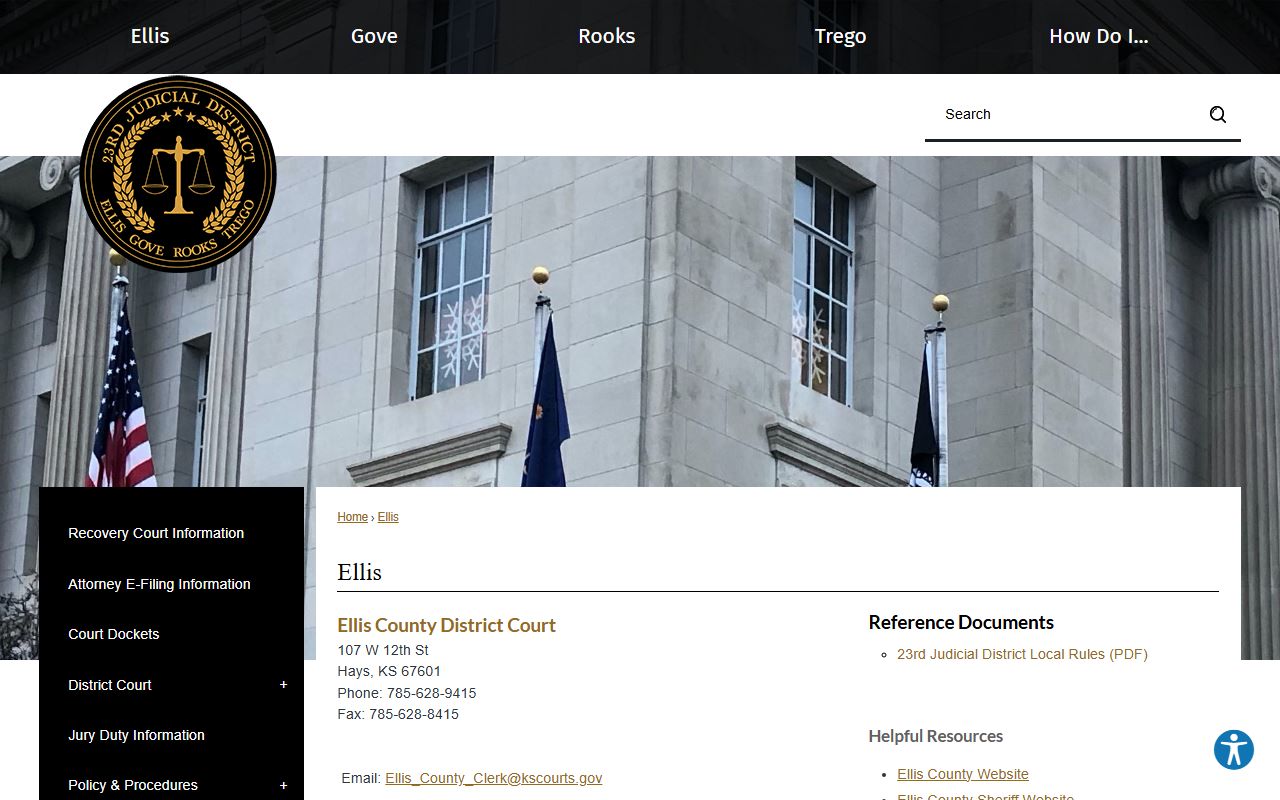
Use the court clerk for filed case access, especially when online records do not show the arrest-related case yet.
Ellis County Charge vs Conviction
A charge is an accusation filed in court. A conviction is a final result based on a guilty plea, no contest plea accepted by the court, or verdict. The difference matters for employment, licensing, housing, immigration, firearm rights, and court-cost questions. It also matters for plain accuracy. Court records after a jail arrest may show serious charges at the start of a case, but those charges can later be reduced or dismissed.
| Point of Comparison | Charge | Conviction |
|---|---|---|
| Stage | Accusation filed by the prosecutor. | Final court result after plea or verdict. |
| Proof level | Based on probable cause and charging review. | Requires proof accepted by plea or beyond a reasonable doubt at trial. |
| Can change? | Yes. It can be amended, reduced, added, or dismissed. | Yes, but changes usually require later court action such as appeal, correction, or expungement. |
| How to read it | Look for current count status and next hearing. | Look for disposition, sentence, supervision, and later expungement orders. |
KORA And Ellis County Records
Kansas public access starts with the Kansas Open Records Act. K.S.A. 45-215 identifies the act, and the broader K.S.A. 45-216 through 45-222 article covers inspection, procedures, fees, exemptions, and enforcement. KORA does not make every criminal justice record public. Criminal investigation records, criminal intelligence, protected personal information, and criminal history record information may be closed, limited, or routed to a state criminal-history channel.
The sheriff's Ellis County Sheriff's Office KORA policy says requests must be written and include the requestor name, mailing address, phone number, and detailed information about the records sought. Office hours are 8 a.m. to 4:30 p.m., Monday through Friday except official state holidays. Requests received after 4:30 p.m. are logged on the next business day. Fees may be estimated and required in advance. The sheriff's office must respond no later than the third business day after receipt, though the response can say more time is needed or that the record is closed by law.
The official sheriff KORA policy page is the local access channel for booking records not shown in the jail log.
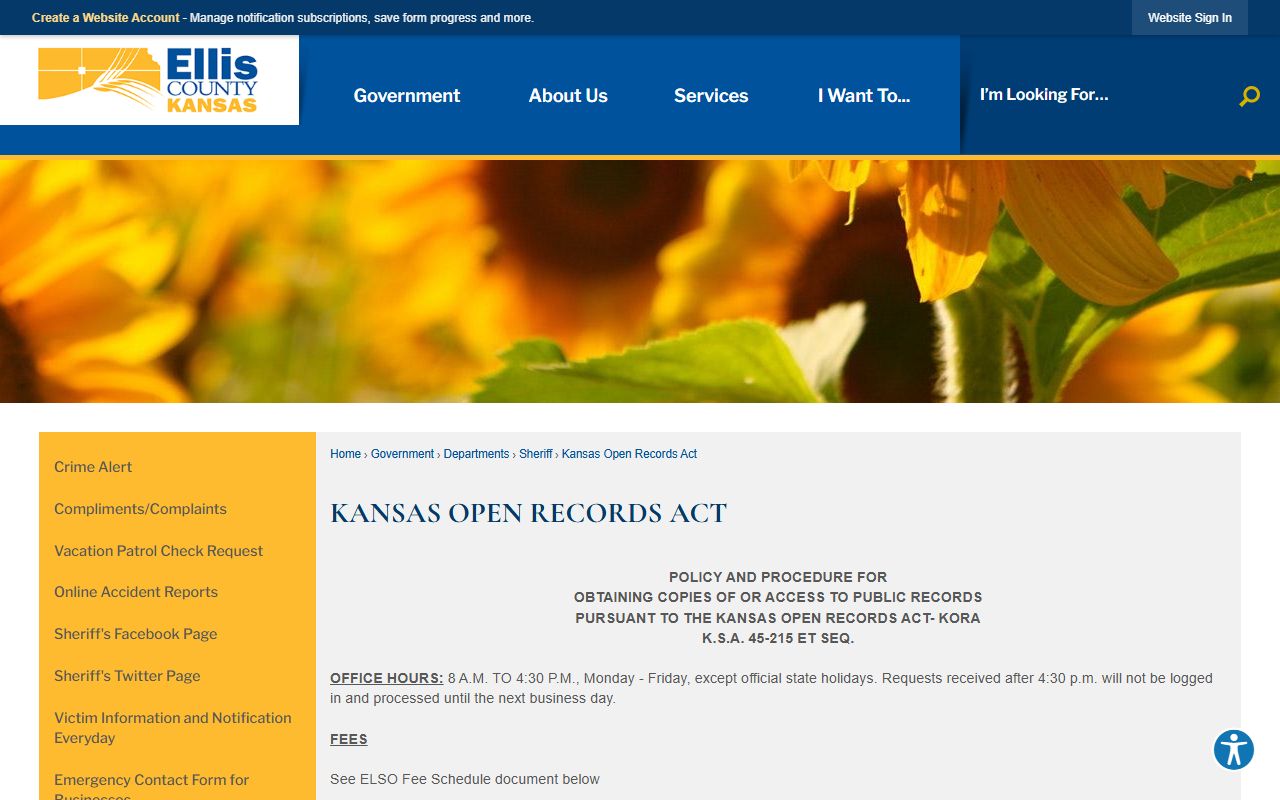
Use KORA for sheriff records, but use the court clerk or Kansas Case Search for filed court records after an arrest.
Sealed And Expunged Arrest Records
Restricted access is different from a clean search result. Some juvenile, sealed, investigation, and protected records may not appear in the same way as ordinary public criminal cases. Kansas also has expungement laws. K.S.A. 21-6614 covers expungement of certain convictions, arrest records, and diversion agreements. K.S.A. 22-2410 covers qualifying arrest-record expungement. Eligibility depends on the event, outcome, waiting period, and court order.
Sealed and expunged are often used as if they mean the same thing, but they do not always work the same way. Sealing usually means public access is blocked or limited while the record still exists. Expungement is a court-ordered remedy that changes public access and legal treatment for eligible records. Law enforcement, courts, licensing bodies, or other authorized users may still have access in some situations allowed by law.
| Point of Comparison | Sealed | Expunged |
|---|---|---|
| Public view | Hidden or limited from ordinary public access. | Removed or treated as unavailable to the public under the expungement order. |
| Record existence | The record still exists with restricted access. | The record may still exist for limited legal purposes, depending on Kansas law and the order. |
| Typical path | By law, court rule, or specific court order. | By petition and court order when the statute allows it. |
| Ellis County impact | A public search may not show the same details. | Public case and arrest access may change after the order is entered. |
Important: Ellis County Inmate Population is not a consumer reporting agency, and court data cannot be used for FCRA-covered screening decisions.